


Billy Beane didn’t invent baseball statistics. You could be forgiven for thinking that after watching the movie Moneyball.
Bill James had been developing sabermetrics for decades before Beane took over the Oakland A’s. Beane’s predecessor, Sandy Alderson, had already begun applying some of those ideas, including the importance of on-base percentage (OBP) and avoiding outs.
The breakthrough was using the data systematically to answer a much more important question: what actually drives wins?

Answering that question gave Billy Beane a way to compete with teams with far more money. During his tenure as General Manager, the A’s became consistent contenders and won six American League West titles.
Baseball already had plenty of stats. Teams tracked all of them. The problem was that decision-making still relied heavily on conventional wisdom without clearly connecting those metrics to winning.
I think community has the same problem today.
For years, I pushed back on the idea that community “doesn’t have a data problem.” I argued that it absolutely was a data problem. But I’ve changed my mind. Most communities already have the data.
We report member growth, event attendance, engagement scores, posts, replies, active users, and dozens of other measures. Those numbers tell us what is happening in a community. They rarely tell us what that activity is worth or why it matters to the business.
Community has its own version of the Moneyball problem. The challenge is figuring out which activities and behaviors are connected to outcomes like retention, product adoption, expansion, referrals, advocacy, pipeline influence, and lower support costs.
The result is that we often answer the wrong questions. Instead of asking whether engagement went up, we should be asking which forms of engagement are linked to customers staying longer. Instead of celebrating record event attendance, we should be asking whether attendees refer customers more often or move through the sales pipeline faster. Instead of counting how many questions members answer, we should be asking whether those interactions reduce support burden or improve product adoption.
Once you start thinking this way, the goal becomes identifying the specific community behaviors that create economic value and measuring them consistently.
That is the problem I am building TribeROI to solve.
TribeROI gathers community data wherever it exists across community platforms, forums, content sources, social media, and elsewhere. It organizes that data across sources, analyzes the relationships between behaviors and outcomes, and identifies signals that attribute community engagement to business results.
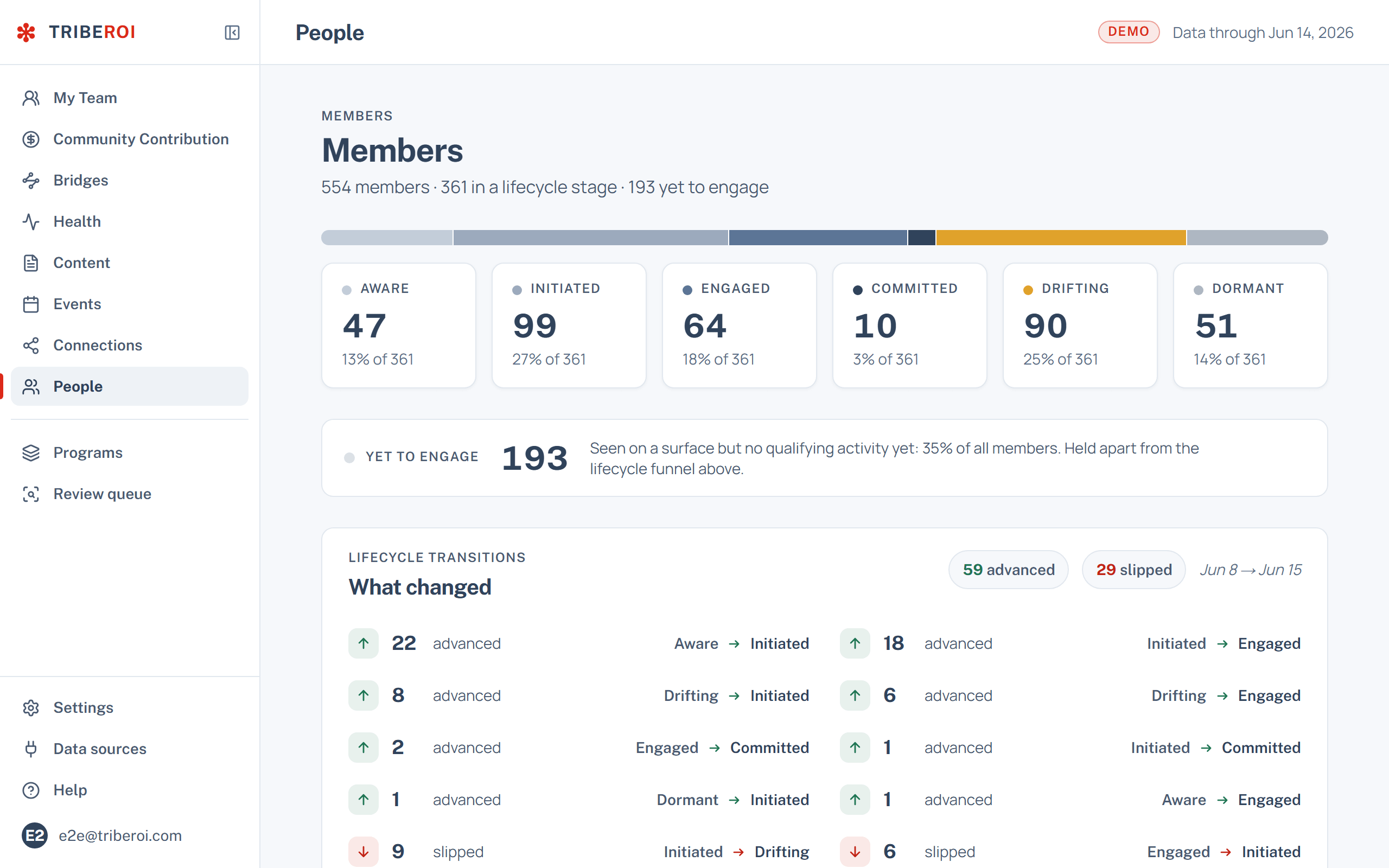
Most community dashboards stop at describing activity. TribeROI is built to explain which activity matters, what outcomes it influences, and where a company should invest more or less as a result.
The model is straightforward: community behavior leads to a business outcome, and that business outcome has economic value. The difficult part is establishing the connection between those steps with enough rigor that someone can actually make a decision from it.
That also means challenging the idea that every community is so different that meaningful standardization is impossible. A developer community, customer community, partner community, and professional network will create value in different ways. The available data, the weighting of that data, and the most important outcomes will differ. There is no argument there.
But the underlying measurement logic does not need to be reinvented every time. Retention impact, support deflection, product adoption, referrals, advocacy, pipeline influence, expansion, and other outcomes can all be approached using repeatable analytical models. All that changes is how you tune the models based on the type of community.
Moneyball showed baseball that the market was placing too much weight on the wrong things. TribeROI is doing the same thing for community. It identifies which behaviors drive business outcomes and prove their value with repeatable math.
The v3 release moves TribeROI further in that direction. Bridges shows the evidence that what happens inside a community leads to real business results. The Multi-Model Attribution feature estimates how much the community contributed to each deal or renewal. All of this rolls up into the Community Contribution view that provides explainable numbers showing the impact across business objectives.
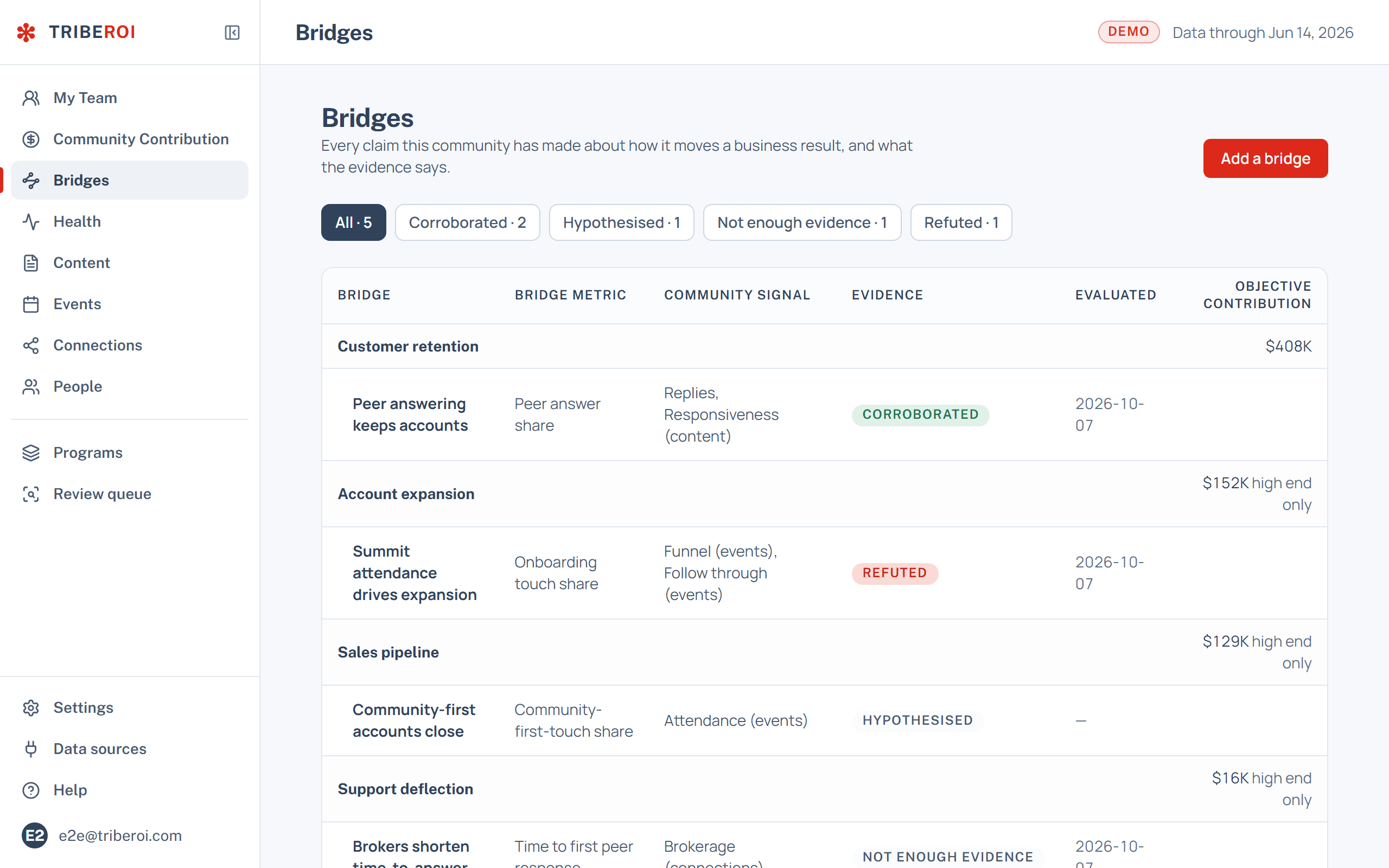
The goal is to give community teams Moneyball-like powers. That means helping them to understand whether their work changed something meaningful for the business and how much that contribution was worth. If a highly visible program generates lots of activity but has little relationship to retention or cost reduction, that is useful to know. If a relatively small program turns out to be strongly associated with expansion or customer success, that is even more useful. Once you know which activities create value, you can make better decisions about where to invest time, money, and people.
That is ultimately what Moneyball was about: using measurement to make better decisions.
Community already has much of the data. The next step is proving which behaviors create business value, and how much.
Mark